Most owners can tell you what they pay in rent. Far fewer can tell you how many software subscriptions their company pays for.
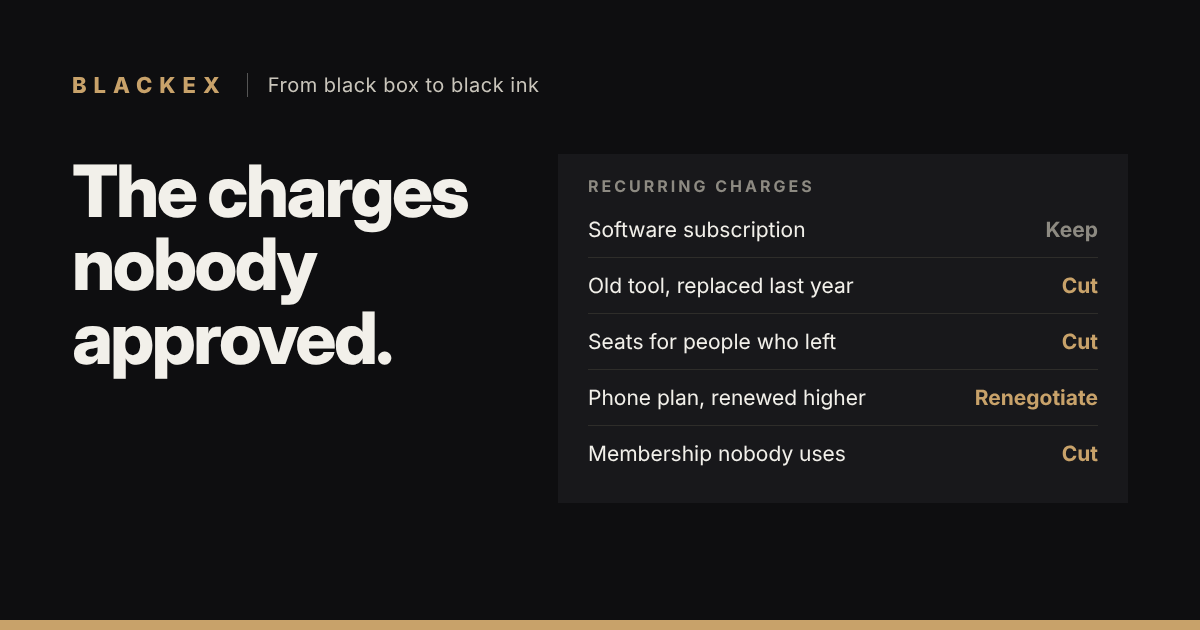
That isn't carelessness. Recurring charges are built to be forgotten. Someone starts a free trial and a card goes on file. A price goes up at renewal and the email lands in a folder nobody reads. A tool gets replaced, but the old one keeps billing.
None of these charges is big on its own. Together, they are overhead that grows every year without anyone deciding it should.
Why this matters more than it looks
A dollar you stop paying in overhead goes straight to profit. A dollar of new sales does not. If your profit margin is 10%, you need about ten dollars of new sales to add what one dollar of cut overhead adds.
A forgotten charge is the cheapest profit you will ever find.
The one-hour check
Block one hour this week. Bring your bookkeeper if you have one.
- Pull the last three months of statements for every business bank account and credit card, including any card an employee uses for company purchases.
- List every charge that shows up more than once: software, subscriptions, phone lines, memberships, equipment leases, service contracts, auto-pay vendors.
- For each line, write the monthly cost, who uses it and when it renews.
- Mark each one Keep, Cut or Renegotiate.
- Put every renewal date on your calendar 30 days ahead.
Three months catches most monthly charges. For annual ones, search the last 12 months of statements for "annual," "renewal" and "subscription."
Four questions for every line
- Does anyone use it? Check logins, not opinions. Many tools show when each user was last active.
- Are we paying for more seats than people? Seats often stay on the bill after someone leaves.
- Do two tools do the same job? It's common to keep paying for the old one after switching.
- When did the price last change? If it went up and nobody pushed back, ask for a better rate or shop it.
A made-up example
This is an illustration, not a real client. A 25-person services firm runs the check and finds 41 recurring charges. Six are tools nobody has logged into for 90 days. Eleven seats belong to people who left. One phone contract renewed at a higher rate. Cutting and trimming saves $900 a month, or $10,800 a year. At a 10% margin, that's the same profit as about $108,000 in new sales.
Your numbers will be different. You only find them by looking.
What not to cut blindly
Some recurring charges protect you. Insurance, data backups and security tools belong in a separate conversation. Before you drop or change an insurance policy, talk to your broker. Before you cancel a contract early, read the termination terms, and check with your attorney if there's a penalty.
The goal isn't to spend less on everything. It's to stop paying for things nobody chose.
Make it a habit
Give one person ownership of the recurring-charge list. New subscriptions go through them, with a named user and a renewal date. Review the list every quarter, before the renewals hit, not after.
Start here
This check takes an hour. Finding the rest of what your numbers aren't telling you takes a second set of eyes. Book a free BOI Snapshot: a 30-minute conversation, a 20-question assessment and a 45-minute readout.